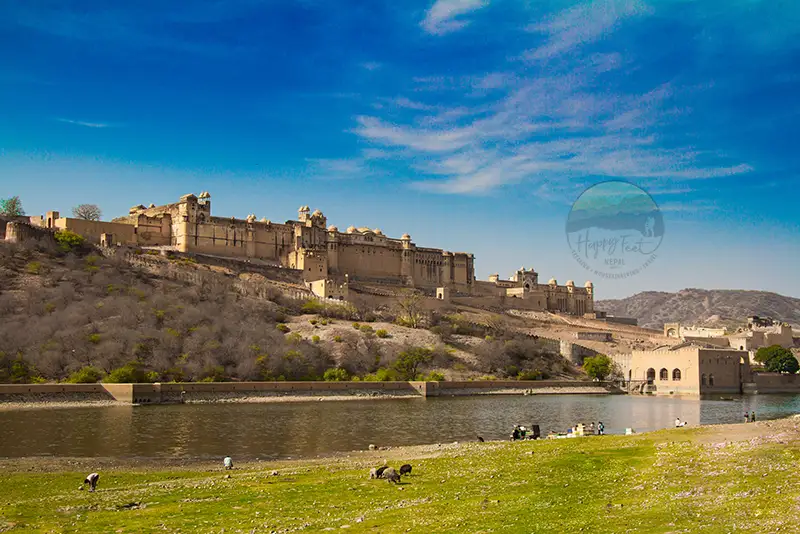
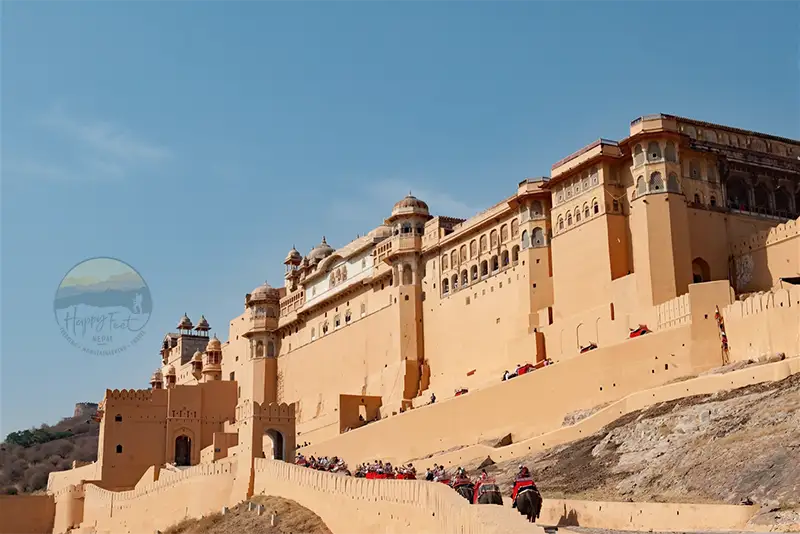
Breakfast at the hotel. Later, visit the Amber Fort, stunningly situated on a hillside overlooking a lake, 11km from Jaipur. Amber was the capital of Rajasthan for six centuries and the core land of Rajput history. Nowadays, the city is practically abandoned. The objective of the visit is to see and admire its imposing palace. The palace stands on the steep hill slope behind Maota Lake, retaining an air of great beauty. The visit to the palace can be made on foot, by Jeep, or by elephant-back safari, which is the most preferred option. The construction of the Palace/Fort was initiated in the 1592s by Raja Man Singh, the Rajput commander of Akbar’s army and later extended and completed by Jai Singh. The “Hall of Public Audience,” with a double row of columns and latticed galleries, is reached by an imposing stairway. The Fortress also contains a temple with doors made of Silver dedicated to Goddess Kali. Next, walk over to the Hall of Victory, noted for its inlaid panels and glittering mirror ceiling. The “Hall of Pleasure” is on the opposite side with an ivory-inlaid sandalwood door, and the “Hall of Private Audience” is extraordinary with exquisite murals. However, the highlight of the Fort is the “Hall of Mirrors”, whose interior is encrusted with tiny mirrors, sparkling like a diamond in candlelight. The oldest part of the palace is Raja Man Singh’s apartments, where each of his dozen wives had a separate suite.
Afternoon: Tour of Jaipur City. Jaipur city is a living testament to one of the most remarkable rulers of his age, Jai Singh II, a highly talented ruler in politics and warfare. However, the credit for the pinkness of the city goes to Maharaja Man Singh, who dressed up the city in the welcoming symbolic colour following the visit of the Prince of Wales and, later, Edward VII, who visited Jaipur in the 1876s.
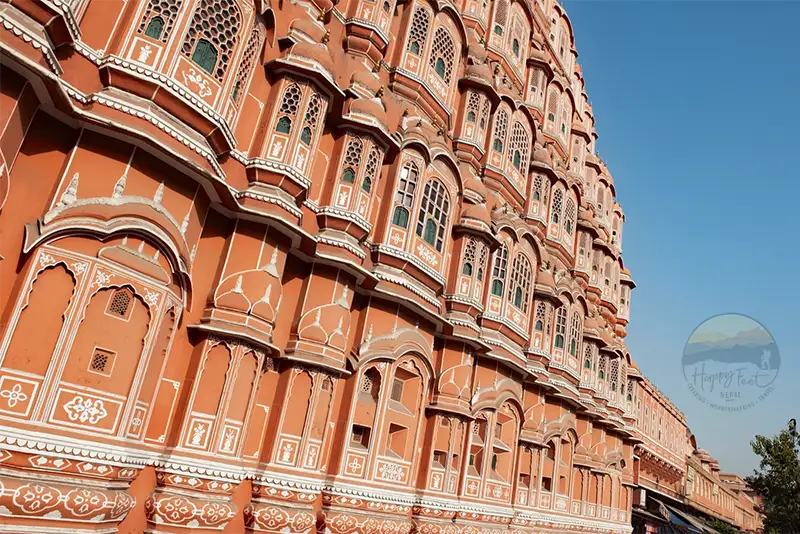
The City Palace and Museum visit comprises several courtyards, gardens, and buildings that blend Rajasthani and Mughal architecture. The former Maharaja still resides in one of its wings, dating back to the 18th century, and features a blend of Rajput and Mughal styles. The museum contains an extensive collection of art, miniature paintings, carpets, costumes and dresses, enamelware, old weapons, and an armoury of guns and swords. The Jantar Mantar, a renowned astronomical observatory built in 1728 by Jai Singh, and Hawa Mahal, also known as the Palace of the Winds, constructed in the 1790s, are Jaipur’s most famous monuments of Rajput architecture. Hawa Mahal consists of 5 floors, of which only the multi-windowed façade remains.
Note: The Archaeology department has limited the number of trips and times to Amber Fort by elephant, so it is possible that Amber Fort may not be accessible on the day of the visit, and we will have to access it by Jeep instead. Therefore, an elephant-back tour cannot be guaranteed.